Skip to content
Memorisation in the early stages of learning piano (part 2)
While working on memory development during piano lessons, attention must be paid to auditory transposition. The student must be asked to transpose easy melodies, as “disassociation” of sets of sound and motor images occurs then. On account of a changed layout of black and white keys, the cooperation of motor memory is impeded, which is precisely the aim, because the student can no longer mechanically recreate the movements from “finger” memory, but he/she must use their auditory memory (“sound images”).
Children also memorise through the use of associations with an image described in a piece title, which plays a significant role in shaping musical imagination. Appropriately chosen, it should lead the imagination to the right track by producing a relevant image and lending a specific character to the performance. Little musicians are excellent at sensing the expression of musical pieces featuring titles that speak to their imagination. In the fragment of a piece presented below every young performer will hear a clock ticking, which is realised with the left hand, and then a clock striking hours in bars 9-11.
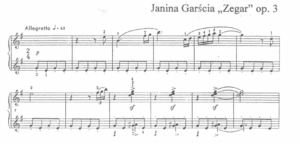

Sometimes an attempt at choosing a title may substantially aid in memorising technical exercises or studies. It helps a child to notice a harmonic, rhythmic and formal structure of the music piece. Searching for adequate associations develops intellectual memory, because it requires the simplest notation analysis comprehensible to the child. Such an “analysis” helps, e.g. to notice that the left hand repeats the melody previously played by the right hand, like in G.L. Demaux’s ‘Study’:
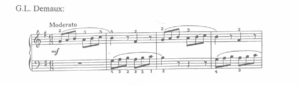

Children may associate these studies with a duo, a conversation between a child (the soprano) and an adult (the bass), or parrot-fashion repetition. Simultaneously, it is possible to expand the scope of a pupil’s musical vocabulary through the introduction of the concept of imitation. When preparing such simple exercises, we may additionally work on auditory memory making attempts at transposing them into other simple keys.
The youngest novice musicians frequently experience difficulties with remembering piano register in which they are supposed to perform a given piece. Such difficulties are caused by their poor knowledge of said registers, making it absolutely indifferent to such novices whether they play one octave higher or lower. In order to facilitate finding the keys and remembering the types of sounds of individual registers, an introduced repertoire should contain pieces that encompass not only the middle, but also the lower and the upper piano registers. For instance, I. Garztecka’s ‘Bears’ dance’ familiarises children with low sounds, while S. Maykapara’s ‘Dew drops’- with high sounds.
Another method that can help with memorisation is, in my opinion, setting lyrics to a piece. They ought to be simple words, easily comprehensible to a child, composed with the child’s participation.
Edyta Lajdorf BMus (Hons) RCM, MMus, LRSM (Teaching), SMISM
If you are interested in Piano lessons in London, please get in touch.
